9 min read
Disclosure: As an Amazon Associate and eBay Partner Network publisher, we earn from qualifying purchases. This doesn’t affect what we recommend or how we describe it.
Choosing the right CO2 regulator for a planted aquarium is a make-or-break decision for stable, healthy plant growth. The sheer variety—single stage, dual stage, mini, solenoid-equipped, basic needle valve, multi-gauge—can be overwhelming, especially when every regulator looks similar online but performs very differently in real-world tanks. This guide breaks down the practical differences, exposes common pitfalls, and gives you the real specs that matter so you can invest with confidence and avoid the wasted money and frustration that comes from buying the wrong CO2 gear. For more detail, see Aquatic Gardeners Association homepage.
What Home Aquarists Really Need from a CO2 Regulator
Most hobbyists searching for aquarium CO2 regulator reviews fall into the beginner to intermediate range. You’re likely running a tank between 10 and 75 gallons, aiming for lush plant growth, and want reliable CO2 delivery without risking fish or fluctuating pH. The big questions on your mind: For more detail, see FishBase global species database.
- Will this regulator maintain a stable bubble rate for weeks, or will I be constantly fiddling with it?
- Is a dual stage regulator worth the extra cost for a home-sized tank?
- How do I avoid dangerous end-of-tank-dump (EOTD) CO2 spikes?
- Can I use this regulator with standard paintball or beverage cylinders, or only with industrial tanks?
- Is a built-in solenoid (for timer control) reliable, or just another failure point?
The answers depend on your tank size, your CO2 goals, and your tolerance for maintenance. Here’s what you need to know before you buy.
CO2 Regulator Configurations Compared for Planted Aquariums
| Configuration | Stages | Bubble Rate Stability | Solenoid Included | Compatible Cylinder Types | Price |
|---|---|---|---|---|---|
| Single Stage Basic | 1 | Moderate (±1-2 bpm drift/week) |
No | Standard CGA320 only | $ |
| Single Stage w/ Solenoid | 1 | Moderate (±1 bpm drift/week) |
Yes (120V/240V) | Standard CGA320 only | $$ |
| Dual Stage Professional | 2 | High (<0.5 bpm drift/month) |
Optional/Included | Standard CGA320 & DIN477 | $$$ |
| Mini Regulator (Paintball) | 1 | Variable (±2-3 bpm drift/week) |
Optional | Paintball, SodaStream | $$ |
| All-in-One Nano Kit | 1 | Low (manual adjust often) |
No | Disposable cartridges | $ |
The price column compares within this guide: $ is the budget end, $$ mid, $$$ premium. For exact, up-to-date prices, see the live listings lower in the article.
Why Stage Design Matters: Single vs Dual Stage in Real Tanks
Single stage regulators are common in the budget and entry-level market. They use a single pressure reduction step, which makes them cheaper and more compact. However, as the CO2 cylinder empties, the output pressure can spike—a phenomenon known as end-of-tank-dump (EOTD). In practice, this means your bubble rate can suddenly double or triple overnight, risking fish and causing wild pH swings. For tanks under 20 gallons with frequent cylinder swaps, this may be manageable. For larger or high-value setups, it’s a real risk.
Dual stage regulators use two pressure reduction chambers, virtually eliminating EOTD. Output remains steady until the cylinder is nearly empty. According to specifications published by manufacturers and widely reported by hobbyists, a well-tuned dual stage regulator can hold a 1-2 bubble per second rate steady for months with less than 0.5 bpm drift. For tanks over 30 gallons or for those wanting set-and-forget stability, dual stage is generally considered worth the premium.
Evaluating Bubble Rate Stability: What to Expect
The most common frustration with cheap regulators is the need for constant adjustment. A good regulator should maintain your target bubble rate (measured in bubbles per minute, bpm) for at least a week without touch-up, and a top-tier dual stage setup can stay steady for a month or more. Always check for a fine needle valve—look for valves labeled as 1/8″ or finer, as these allow precise control. Avoid regulators with coarse, plastic valves or with no needle valve at all; these are nearly impossible to dial in for planted tanks.
Solenoid Valves: Convenience vs Longevity
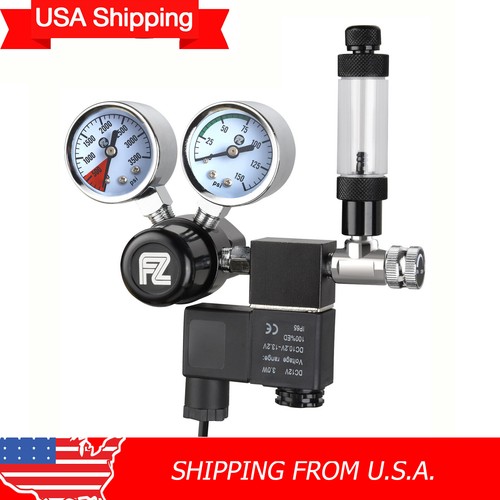
A solenoid valve lets you automate CO2 delivery with a timer, shutting off gas at night to save CO2 and prevent dangerous pH drops. Most modern solenoids are rated for 120V or 240V and draw 2-5 watts. While solenoids add convenience, they are a common failure point on budget regulators. Look for solenoids rated for at least 1 million cycles and with a clear replacement path. Research and user reports suggest that higher-quality solenoids last 3-5 years, while cheaper ones sometimes fail in months.
For maximum reliability, some aquarists run CO2 24/7 and skip the solenoid, but this is less efficient and can stress livestock. For most setups, a solenoid is worth the small added cost—just budget for a replacement down the road.
Cylinder Compatibility: CGA320, Paintball, SodaStream, and Cartridges
Standard full-size CO2 cylinders use the CGA320 thread in North America and DIN477 in Europe. Most regulators target these. Paintball regulators use a smaller thread and are popular for nano and mid-size tanks (10-30 gallons) where space is at a premium. Adapters exist, but beware: cheap adapters can leak or strip. For ultra-compact setups, all-in-one kits use disposable cartridges (8g or 16g), but these need frequent replacement and cost more per gram of CO2 delivered.
If you foresee scaling up, invest in a regulator that can handle both standard and paintball cylinders via adapter, and check for compatible thread specs in the product manual (e.g., CGA320, W21.8, or paintball pin-valve).
Related Guides
- Aquarium Cooling Fans That Actually Work: A No-Nonsense Guide
- Root Tabs for Aquarium Plants That Actually Work
- The Best Hang-On-Back Aquarium Filters, Reviewed and Compared
- Inline Aquarium Heaters That Are Worth It: Our Honest Reviews
- How to Clean Aquarium Plants Before Planting: A Step-by-Step Guide
- Browse all CO2 Equipment →
- CO2 Injection Systems That Are Actually Worth Using in Planted Tanks
- Our guide to Aquarium Substrates for Planted Tanks: What Actually Works
Mini and Nano Regulators: When Space is Tight
For desktop tanks or rimless cubes under 15 gallons, mini regulators are tempting for their size and simple setup. They’re usually single stage and may only thread onto paintball or SodaStream cylinders. Expect more frequent bubble rate drift—±2-3 bpm per week is typical—and a need for manual adjustment after each cylinder swap. If you’re running an aquascaped nano and want minimal gear on display, this is a reasonable tradeoff, but know you’ll be tweaking it more often.
See today’s dealsHow to Judge Needle Valve Quality
The needle valve is the heart of bubble rate control. High-quality valves are machined from brass or stainless steel, with a fine, long taper. Look for valves advertised as “fine control” or with a thread pitch of 1/8″ or finer. A well-made valve allows you to move from 0.5 to 2 bubbles per second with just a quarter-turn and holds steady for days. Cheap valves have play or coarse threads, making fine adjustment nearly impossible—these are the source of most “my CO2 is all over the place” complaints on forums.
Pressure Gauges: What’s Actually Useful
Dual gauge regulators display both cylinder pressure (800-1000 psi full, dropping as it empties) and working pressure (typically 20-40 psi for aquarium use). For most home setups, a working pressure of 30 psi is ideal for standard ceramic diffusers; higher pressure (40-50 psi) may be needed for inline atomizers. Single gauge setups are common in mini/nano kits, but you lose the ability to monitor cylinder levels. Avoid regulators with unreadable, unlabeled, or “decorative” gauges—they’re functionally useless.
Compare optionsCommon Pitfalls: What to Watch Out For
- Thread leaks: Always use a new nylon washer or CO2-rated O-ring between the regulator and cylinder. Never rely on Teflon tape for CO2 threads.
- Cheap solenoids: If it gets hot to the touch or buzzes loudly, it may fail early—budget for a replacement or choose a regulator with a standard solenoid fitting.
- Plastic needle valves: These strip easily and rarely hold a setting—stick with metal.
- Adapters: Only use adapters rated for CO2 pressures (800-1000 psi). Brass is best.
- Regulator creep: If your working pressure rises after 24-48 hours, the regulator is faulty—return or replace immediately.
FAQ: CO2 Regulator Choices for Planted Tanks
Do I really need a dual stage regulator for a 20-40 gallon tank?
For tanks in this range, a quality single stage regulator with a good needle valve and solenoid is usually adequate if you monitor your bubble rate weekly and change cylinders before they’re completely empty. Dual stage offers extra peace of mind—especially if you travel or want set-and-forget stability—but isn’t strictly required for mid-size tanks.
Can I use a paintball CO2 cylinder with a standard aquarium regulator?
Not directly—paintball cylinders use a different thread (5/8-18 UNF) and a pin-valve system. Adapters are available, but make sure they’re CO2-rated brass, not aluminum. Some regulators are designed to accept both with simple thread swaps; check product specs carefully.
How do I know if a solenoid valve is safe and reliable?
Look for a solenoid rated for at least 1 million cycles, with a CE or UL certification. It should not get hot during operation and should make only a soft click. Avoid solenoids with plastic bodies or no listed certification, as these are prone to early failure.
What working pressure should I set for my aquarium CO2 system?
Most ceramic diffusers perform best at 25-35 psi. Inline atomizers may require 40-50 psi. Start low and increase only if you see large bubbles or poor diffusion. Never exceed the regulator’s rated output pressure (usually 60 psi for aquarium models).
How often will I need to adjust the bubble rate on a typical regulator?
With a good dual stage regulator, once every 2-4 weeks is typical. Single stage units may need weekly tweaks, especially as the cylinder empties. Mini/nano regulators often require adjustment every few days, especially after swapping cylinders or cartridges.
What’s the most common cause of CO2 leaks in home setups?
The regulator-to-cylinder connection is the #1 culprit, usually from a worn or missing washer. Always use a fresh nylon or CO2-rated washer, and hand-tighten firmly. Check all connections with soapy water after setup—any bubbles indicate a leak that must be fixed before running CO2.
Can I use a mini regulator on a large tank?
Mini regulators are designed for nano and small tanks, typically under 20 gallons. On larger tanks, they may struggle to maintain a stable bubble rate and could require frequent cartridge changes. For tanks above 20 gallons, a full-size regulator is a more reliable and cost-effective solution.
Is a dual gauge regulator always better than a single gauge?
Dual gauge regulators let you monitor both cylinder and working pressure, which is useful for tracking CO2 levels and spotting regulator issues early. However, for very small or nano setups where space is limited, a single gauge may be sufficient. For most standard planted tanks, dual gauges add convenience and peace of mind.
How do I prevent end-of-tank-dump (EOTD) with a single stage regulator?
To minimize the risk of EOTD, replace your CO2 cylinder when the pressure drops below 500 psi rather than running it completely empty. Regularly monitor your bubble rate, and consider using a high-quality needle valve to help buffer sudden pressure changes. For critical tanks, dual stage regulators provide the best protection against EOTD.
Final Thoughts: Choosing the Right Regulator for Your Setup
The best CO2 regulator for your aquarium depends on your tank size, desired stability, and willingness to perform regular adjustments. For most home setups, a single stage regulator with a quality needle valve and solenoid offers a good balance of cost and performance. Dual stage regulators are ideal for larger or high-value tanks where long-term stability is a must. Always prioritize reliable needle valve control, solid construction, and proper cylinder compatibility over flashy features. With the information above, you’ll avoid common money-wasters and set yourself up for thriving, algae-free plant growth.
Check current pricesLast updated: May 2026 · About our research