9 min read
Disclosure: As an Amazon Associate and eBay Partner Network publisher, we earn from qualifying purchases. This doesn’t affect what we recommend or how we describe it.
Most guides claim every aquarium needs a full-time air pump—but for a well-planted tank, that isn’t always true. The real value of a rechargeable aquarium air pump shows up during power outages, transport, or when you need backup aeration for sensitive livestock. Choosing the right model isn’t just about battery life; it’s about matching output, noise, and real-world reliability to your setup so you aren’t left scrambling in an emergency.
What a rechargeable air pump actually does for planted tanks
Planted freshwater tanks typically rely on plant photosynthesis to oxygenate water during the day. At night or during a blackout, oxygen can drop sharply, especially in densely stocked tanks. A rechargeable air pump gives you a portable, battery-powered way to keep water moving and oxygen levels stable when the main filter or standard air pump stops. This is critical for fish, shrimp, and even some plants that can suffocate in stagnant, deoxygenated water.
Unlike plug-in models, rechargeable pumps use an internal battery—usually lithium-ion or nickel-metal hydride—to provide hours of runtime without mains power. Some run as short as 4 hours, others push past 24 hours on a single charge. However, not all are created equal; some struggle to move enough air for anything but a small quarantine tank, while others are noisy or unreliable under real-world loads.
Key pump specs that actually matter
Ignore the marketing fluff about “whisper-quiet” or “multi-mode” operation. Three numbers matter most for planted tank use:
- Air output (L/min): For most planted tanks under 40 gallons, you want at least 1.5 L/min. Heavily stocked tanks or larger volumes need 2–4 L/min or more.
- Battery runtime (hours): Emergency use means you want a minimum of 8 hours at full output. Some pumps advertise 24+ hours, but often at reduced flow rates. Always check the runtime at your needed power level.
- Noise level (dB): Many rechargeable pumps are louder than plug-in models. Anything under 45 dB is reasonable for a living room; above 50 dB can get annoying, especially in small spaces.
Other useful specs include the number of outlets (for running multiple air stones), weight (for portability), and charge time (some take 6+ hours to fully recharge).
Comparison table: Rechargeable air pump configurations for home aquariums
| Configuration | Air Output (L/min) | Battery Runtime (hours) | Noise Level (dB) | Number of Outlets | Price |
|---|---|---|---|---|---|
| Single-cell mini lithium | 0.7–1.2 | 4–10 | 42–52 | 1 | $ |
| Dual-cell compact lithium | 1.5–2.2 | 8–20 | 38–48 | 1–2 | $$ |
| High-capacity multi-cell | 2.5–4.0 | 16–30 | 45–55 | 2 | $$$ |
| Manual hand-pump backup | 0.2–0.5 | — | — | 1 | $ |
The price column compares within this guide: $ is the budget end, $$ mid, $$$ premium. For exact, up-to-date prices, see the live listings lower in the article.
Real-world use: Matching pump type to tank size and needs
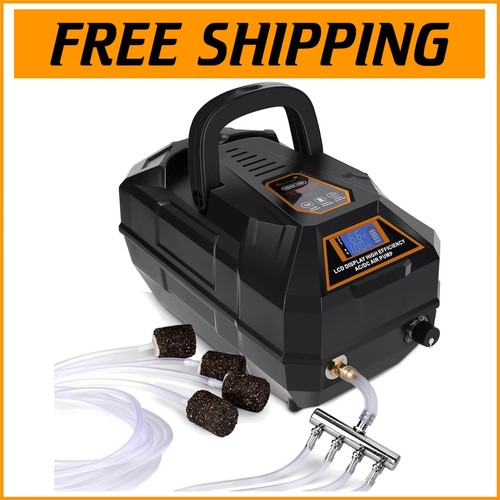
For a 10–20 gallon planted tank with moderate fish stocking, a dual-cell compact lithium pump is a practical choice. It delivers enough air for a single large airstone or two small ones, with 8–12 hours of runtime at usable flow. Larger tanks (30–55 gallons) or setups with high bioloads benefit from a high-capacity multi-cell pump—these can run two outlets for 24 hours, but expect more noise and a heavier unit.
Single-cell mini pumps are tempting due to their low price and size, but in practice, they struggle to keep up with anything but a small quarantine or nano tank. Manual hand-pump options exist, but these are emergency-only: you must pump them yourself every few minutes to keep air going, which is exhausting for anything longer than an hour.
For planted tanks with CO2 injection, battery pumps are not a substitute for a proper filter, but they can save livestock during a blackout. Always test your pump ahead of time so you know what to expect, and keep it charged—most lithium models lose 10–15% charge per month even when unused.
Check current pricesPump placement and noise: What works in a living room
No rechargeable air pump is truly silent. The loudest part is often the vibration against a hard surface, not the pump itself. Place the pump on a folded towel or silicone mat to reduce noise. Keep the air pump above water level to avoid back-siphoning in case of tubing failure—install a check valve for extra safety.
Some pumps emit a high-pitched whine at maximum output. For nighttime use in a bedroom, stick to models rated under 45 dB and test them at your intended location. If you’re especially sensitive to noise, consider running the pump during the day only, or using it as a last-resort backup.
Always use the manufacturer’s supplied air stone or upgrade to a fine-pore stone for better oxygenation with less noise. Avoid cheap, heavy stones that overwork the pump and sap battery life.
See today’s dealsCharging, maintenance, and backup planning
Lithium-ion pumps need regular top-up charging—ideally once a month if left unused. Letting the battery drain completely shortens its lifespan. Some models let you run the pump while charging, but this isn’t universal; check the manual before relying on this feature.
Keep the charging cable handy and avoid using USB chargers that exceed the pump’s rated amperage (usually 1A for smaller pumps, up to 2A for larger models). Overcharging can cause battery swelling or failure. Store the pump in a dry place, away from direct sunlight and humidity, to preserve battery life.
For tanks over 40 gallons or with expensive livestock, keep a spare pump or power bank as a backup. Testing your setup once every few months ensures everything works when you need it most.
Compare optionsBeginner’s pre-purchase checklist
- Measure your tank’s water volume in gallons or liters—output needs scale with tank size.
- Count the number of tanks or air stones you want to run on backup power—each outlet supports only one line.
- Check the maximum runtime you’ll realistically need in your area’s longest typical power outage.
- Test outlet locations—ensure your chosen pump can reach the tank without awkward cable stretches.
- Weigh noise sensitivity—listen to sample recordings (if available) to gauge if a model is tolerable for your space.
- Verify the pump’s charging requirements match your available USB/adaptor ports and wall plugs.
- Read the warranty terms and return policy for hassle-free exchanges if the unit arrives dead or fails early.
Where rechargeable air pumps fit in a planted tank system
Battery-powered air pumps aren’t meant for full-time filtration or CO2 distribution in aquascapes. Their niche is emergency aeration and short-term backup—not replacing your main filter or circulation pump. For tanks with heavy plant mass, you may not need daily air at all, but in any setup with significant livestock, a backup pump is cheap insurance. For more on the role of oxygenation in aquarium health, see the overview at AquariumAdvice.com.
Some hobbyists use rechargeable pumps for fish transport or at club auctions—compact models fit in a backpack and keep bags or buckets aerated for hours. If you travel with fish or shrimp, a lightweight pump with at least 6 hours of runtime is a solid investment.
Related Guides
- Our guide to Wave Maker vs Circulation Pump: Which Is Right for Your Aquarium?
- Our guide to Rechargeable Aquarium Air Pumps That Are Actually Worth Buying
- Booster Pump vs Circulation Pump: What’s the Difference?
- Canister Filter vs Sump Filter: Which Is Better for Your Aquarium?
- Our guide to Fine Gravel vs Coarse Gravel: Which Is Best for Your Aquarium?
- Hang-On-Back vs Canister Filters: Which Is Best for Your Aquarium?
FAQ: Rechargeable aquarium air pumps for home tanks
How long does a rechargeable air pump typically run on a full charge?
Most models provide 8–20 hours at moderate flow (1.5–2.0 L/min). High-capacity versions can run over 24 hours but may reduce air output to reach those numbers. Always check the runtime at your needed flow rate, not just the manufacturer’s “maximum” claim.
Can a rechargeable pump fully replace my main aquarium filter?
No. Rechargeable air pumps only provide surface agitation and oxygenation. They do not circulate water or filter waste. Use them as a backup during outages, not as your main filtration method for a planted tank.
Which is better for a 30-gallon tank: single-cell mini or dual-cell compact?
For a 30-gallon planted tank, a dual-cell compact lithium pump is the better choice. Single-cell minis struggle to deliver enough air volume and have shorter runtimes, while dual-cell models offer higher output and can support one or two air stones for 8–12 hours.
What’s the typical failure mode for these pumps?
The most common issues are battery degradation, internal corrosion from moisture, and air pump diaphragm wear. Store your pump in a dry place and charge it monthly to extend its life. Most failures happen after 1–2 years of intermittent use.
Are rechargeable pumps safe to use around children and pets?
Most are low-voltage and pose little electrical hazard, but keep cords and small parts out of reach. Always use a check valve to prevent water from siphoning back into the pump, which could cause leaks or electrical shorts.
How do I know if a pump will fit my airline tubing and stones?
Nearly all rechargeable air pumps for aquariums use standard 4mm (3/16”) airline fittings, which match most air stones and accessories. Check the product specs and, if in doubt, measure your tubing’s inner diameter before buying.
What kind of warranty or return policy should I look for?
Look for at least a 12-month warranty against defects, and check that returns are accepted for dead-on-arrival or early failures. Some pumps come with only a 30-day policy, which may not be enough to catch battery issues. Save your receipt and test the unit as soon as it arrives.
Final thoughts: Best uses and alternatives
Rechargeable aquarium air pumps are essential for home aquarists who want peace of mind during power outages, transport, or tank emergencies. Their main strengths are portability and ease of use; their main limitations are battery life and air output. For most planted tanks up to 40 gallons, a dual-cell lithium model offers the best balance of runtime, noise, and value. Larger tanks or high-value livestock justify investing in a high-capacity unit or even multiple pumps.
If you live in an area with frequent outages or keep sensitive species, don’t leave this purchase until after you need it. Test your pump, keep it charged, and you’ll avoid the stress of trying to save fish in the dark. For more technical details on aquarium aeration and emergency preparedness, visit the Aquascape Awards resource section.


Last updated: July 2026 · About our research