7 min read
Disclosure: As an Amazon Associate and eBay Partner Network publisher, we earn from qualifying purchases. This doesn’t affect what we recommend or how we describe it.
Choosing your first fish tank should be straightforward, but most beginners get overwhelmed by confusing specs, vague kit promises, and gear that’s either overkill or not up to the job. Here’s how to cut through the noise and select a starter aquarium setup that’s reliable, affordable, and genuinely supports healthy plants and fish—without wasting money on features you don’t need. For more detail, see RSPCA advice on fish tank environments.
What Size Tank Sets You Up for Success?
The most common mistake new aquarists make is buying a tank that’s too small. Anything under 10 gallons is rarely forgiving: water chemistry can fluctuate rapidly, and stocking options are limited. For a planted community tank, a 15-20 gallon (roughly 60-80 liters) rectangular glass aquarium hits the sweet spot. This size is large enough to buffer beginner mistakes, supports a decent plant layout, and fits comfortably in most homes.
Avoid tall or unusually shaped tanks as your first project. Standard rectangles (e.g., 24” x 12” x 16” for a 20-gallon long) are easiest to light evenly and to aquascape. Glass is more scratch-resistant than acrylic, though acrylic is lighter if weight is a concern. The difference in price is usually negligible at these sizes, but glass tends to last longer in the hands of a beginner.
All-in-One Kits vs. Separate Components: Pros and Cons
Starter kits bundle tank, filter, and sometimes lighting and heater. While convenient, many kits cut corners—especially on lighting and filtration. If you want lush plant growth, pay special attention to the light’s actual output (see below). For those willing to choose each part, mixing separate components often yields a more robust, upgradable setup.
Comparison Table: Starter Tank Setup Approaches
| Configuration | Typical Size Range | Lighting Output | Filtration Included? | Upgradability | Price |
|---|---|---|---|---|---|
| All-in-One Glass Kit | 10–20 gal | 8–12 PAR at substrate | Yes (basic HOB) | Limited | $ |
| All-in-One Acrylic Kit | 8–15 gal | 6–10 PAR at substrate | Yes (internal) | Limited | $ |
| Custom Glass + Standalone Gear | 15–30 gal | 15–25 PAR at substrate | No (choose filter) | Excellent | $$ |
| Plug-and-Play Nano Cube | 5–10 gal | 8–15 PAR at substrate | Yes (hidden/integrated) | Moderate | $$$ |
| Standard Glass + Used Gear | 10–20 gal | Varies (user-supplied) | No (user-supplied) | Good | $ |
The price column compares within this guide: $ is the budget end, $$ mid, $$$ premium. For exact, up-to-date prices, see the live listings lower in the article.
Lighting: What Actually Grows Plants?
Most kit lights are just bright enough to see your fish—nowhere near what carpeting plants or red stems need. For a low-maintenance, beginner-friendly planted tank, aim for 15–25 PAR (Photosynthetically Active Radiation) measured at the substrate. This supports undemanding plants like Anubias, Java fern, and Cryptocoryne. If you want to grow carpeting plants or more colorful species, look for lights rated at 20–40 PAR at substrate, or 0.5–1 watt per liter as a ballpark figure.
Light spread is as important as intensity. A 24” tank needs a fixture that covers the full length for even growth. Avoid “clip-on” LEDs for tanks over 15 gallons—they rarely deliver enough output. Most all-in-one kits cap out at 10–15 PAR, so if you’re serious about plants, budget for a dedicated fixture. See today’s deals
Filtration: Reliable, Quiet, and Easy to Maintain
Hang-on-back (HOB) filters dominate starter kits. They’re simple, reliable, and easy to clean. For tanks up to 20 gallons, look for a filter rated for at least 4–6x the tank volume per hour (e.g., 80–120 GPH for a 20-gallon). This ensures adequate turnover and oxygenation for both fish and plants.
Internal filters are common in acrylic kits and nano cubes. They’re quiet and unobtrusive, but often have less biological capacity and can clog faster. Sponge filters (air-driven) are a budget-friendly option and gentle for shrimp or fry, but require a separate air pump and don’t polish water as well as HOBs. For planted tanks, avoid undergravel filters—they disrupt root growth and are outdated for planted layouts.
Heaters: Consistent Temperature Matters
Tropical fish and most aquarium plants thrive at 74–78°F (23–25°C). Many starter kits skip the heater or include an underpowered one. For a 15–20 gallon tank, use a 50–75 watt adjustable heater with a shatterproof casing. Avoid preset heaters; they often run too hot or cold and aren’t reliable in rooms with temperature swings. Place the heater near the filter outflow for even heat distribution.
Substrate: The Foundation of Your Planted Tank
Gravel is cheap and included in many kits, but most plants root poorly in plain gravel. For best results, choose a nutrient-rich planted tank substrate or cap inert sand with root tabs. Look for grain sizes of 1–3 mm—fine enough for roots, coarse enough to allow water flow. A 20-gallon tank typically needs 15–20 lbs (7–9 kg) of substrate to achieve a depth of 1–2 inches across the footprint.
While “all-in-one” substrate bags cost more up front, they save headaches later and support healthy plant growth from the start. Compare options
What about Stocking: Realistic Fish and Plant Choices for Beginners
A good starter tank should allow for a small, stable community. In a 15–20 gallon, you can comfortably keep:
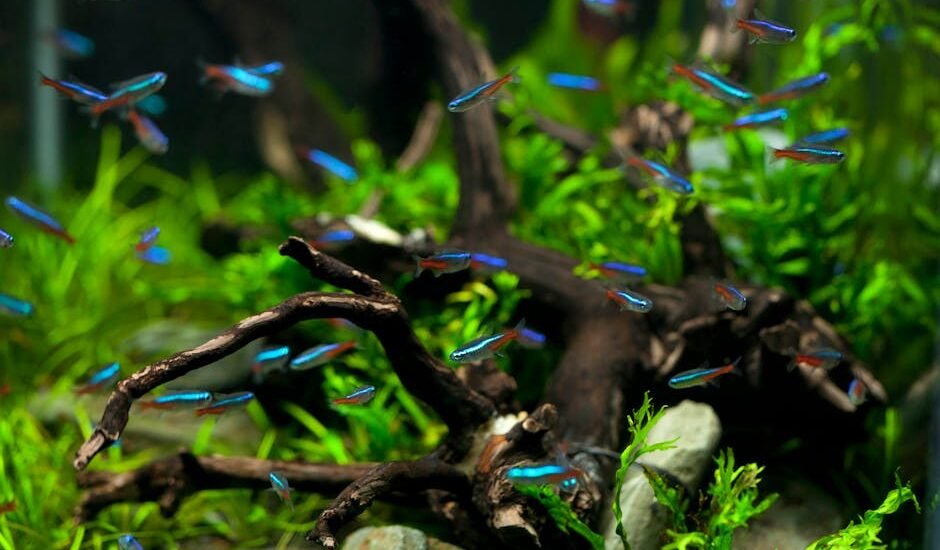
- 6–10 small schooling fish (e.g., rasboras, tetras)
- 1–2 small centerpiece fish (e.g., dwarf gourami, honey gourami)
- 3–5 bottom dwellers (e.g., Corydoras, otos, or kuhli loaches)
- Easy plants like Java fern, Anubias, Cryptocoryne, and Vallisneria
Avoid impulse-buying large or aggressive fish “recommended for beginners.” Overcrowding and incompatible species are the fastest ways to run into problems.
What You Don’t Need (Yet): Unnecessary Upgrades for Starters
- CO2 injection systems—great for advanced aquascaping but not needed for hardy beginner plants
- UV sterilizers—unnecessary for most home setups
- Canister filters—overkill for tanks under 30 gallons and more complex to maintain
- “Smart” controllers or Wi-Fi gadgets—reliable timers and manual controls are simpler and less likely to fail
Stick to proven, low-maintenance gear until you’re ready to experiment. This keeps costs down and lets you learn the basics before adding complexity. View what’s available
Practical Setup Tips: Avoiding Common Pitfalls
- Always test-fill your tank with tap water before adding substrate or fish to check for leaks.
- Rinse substrate thoroughly—cloudy water is a pain to clear once the tank’s running.
- Set up the tank away from direct sunlight, heaters, or air vents to minimize algae and temperature swings.
- Allow your filter and heater to run for at least a week before adding fish—this “cycling” period is crucial for establishing beneficial bacteria.
- Invest in a simple plug-in timer for your lights; 8–10 hours per day is ideal for most beginner plants and helps prevent algae.
FAQ: Gear Decisions for Your First Planted Tank
How big should a beginner aquarium be?
A tank in the 15–20 gallon range is ideal for most beginners. It’s large enough to provide a stable environment, supports a good selection of fish and plants, and isn’t so big that maintenance becomes overwhelming.
Is it worth buying a kit or should I build my own setup?
Kits are convenient and budget-friendly but often compromise on lighting and filtration. If you want to grow live plants and have more flexibility, building your own setup with a standard glass tank and separate gear is a better long-term investment.
What lighting specs should I look for in a planted tank?
Look for a fixture that provides at least 15–25 PAR at the substrate, or about 0.5–1 watt per liter for low-tech plant growth. Avoid “white only” LEDs; a full-spectrum light (including cool and warm whites, some red and blue) gives better plant color and growth.
What type of filter is easiest for beginners?
Hang-on-back (HOB) filters are simple to maintain, offer reliable mechanical and biological filtration, and are easy to clean. Choose a model rated for 4–6 times your tank volume per hour for best results.
Do I need a heater, and what size?
Most tropical fish and plants need a heater. For a 15–20 gallon tank, use a 50–75 watt adjustable heater. Avoid preset models—they’re less accurate and can’t adapt to different room temperatures.
How much should I budget for a complete starter setup?
Expect to spend in the mid-range ($$) for a reliable 15–20 gallon planted tank, including tank, light, filter, heater, and substrate. Kits may be cheaper ($), but plan on upgrading lighting or filtration if you want healthy plant growth.
Final Thoughts: Setting Yourself Up for Success
The best starter fish tank is one that balances size, reliable equipment, and upgrade potential—without overspending or buying features you won’t use. A 15–20 gallon glass aquarium with a full-spectrum LED light, HOB filter rated for your tank size, adjustable heater, and nutrient-rich substrate gives you the flexibility to enjoy aquascaping and a healthy fish community right from the start. Avoid tiny tanks, underpowered lights, and “all-in-one” shortcuts that limit your options. Take the time to choose gear you’ll grow with, and your first tank will be a source of pride—not frustration.
Last updated: May 2026 · About our research