8 min read
Disclosure: As an Amazon Associate and eBay Partner Network publisher, we earn from qualifying purchases. This doesn’t affect what we recommend or how we describe it.
How do you set up a double sponge filter so it actually works—and doesn’t just bubble uselessly in the corner? You want crystal-clear water and healthy plants, not a tangle of tubing or weak flow. Here’s how to choose, assemble, and fine-tune a double sponge filter for a planted freshwater tank, based on real-world trial and error—not just what the packaging claims.
What most buying guides get wrong about double sponge filters
Most guides gloss over the real differences between double sponge filter types and setups. They rarely mention that the wrong size, pore density, or airline configuration can make or break your results. For planted tanks, you need to balance gentle water movement with strong enough biological filtration—too much flow uproots plants, too little and debris collects between leaves. Also, many hobbyists underestimate how much air pump power is needed to drive two sponges effectively, especially in tanks over 20 gallons.
Side-by-side comparison: Double sponge filter setups for planted tanks
| Configuration | Recommended Tank Size | Sponge Pore Size | Air Pump Output Needed | Maintenance Frequency |
|---|---|---|---|---|
| Small, fine-pore (nano tanks) | 10–20 gallons | 40–60 ppi | 1.5–2 L/min | Every 2 weeks |
| Medium, mixed-pore (community tanks) | 20–40 gallons | 30–50 ppi | 2–3 L/min | Every 3 weeks |
| Large, coarse-pore (heavily stocked tanks) | 40–75 gallons | 15–30 ppi | 3–4 L/min | Monthly |
| With integrated uplift tube | 15–40 gallons | 30–50 ppi | 2–3 L/min | Every 3 weeks |
| With external prefilter | 20–55 gallons | 20–40 ppi | 2–3.5 L/min | Monthly |
Quick decision tree
- If your tank is under 20 gallons: Choose a small, fine-pore setup for gentle flow and effective particle capture.
- If you have lots of fish or messy eaters: Go for a large, coarse-pore filter or one with an external prefilter for better debris handling.
- If plant disturbance is a concern: Pick a configuration with an integrated uplift tube to direct flow away from delicate stems.
- If cleaning frequency matters most: A medium, mixed-pore setup offers a balance of low maintenance and good filtration for most community aquariums.
- If you’re on a tight budget: The entry-level small, fine-pore option keeps costs down and is easy to upgrade later.
Why double sponge filters are ideal for planted tanks—and where they fall short
Double sponge filters excel at biological and mechanical filtration without creating strong currents that uproot plants or stress small fish. The twin sponges provide a large surface area for beneficial bacteria—critical for breaking down fish waste and keeping water parameters stable. They’re also easy to clean: just squeeze one sponge in tank water during a water change, so you never lose all your biofilter at once.
However, the main downside is limited chemical filtration. Double sponge filters don’t remove dissolved organics or discoloration (like tannins) as effectively as canister filters loaded with specialty media. You also need to pair them with a reliable air pump, and noise can be an issue if the pump is undersized or vibrates against furniture. For tanks over 55 gallons or with heavy bioloads, you may need to supplement with another filter type or increase maintenance frequency.
For more on why biological filtration matters, see this overview from National Geographic on aquarium ecosystems.
How to set up a double sponge filter: step-by-step guide
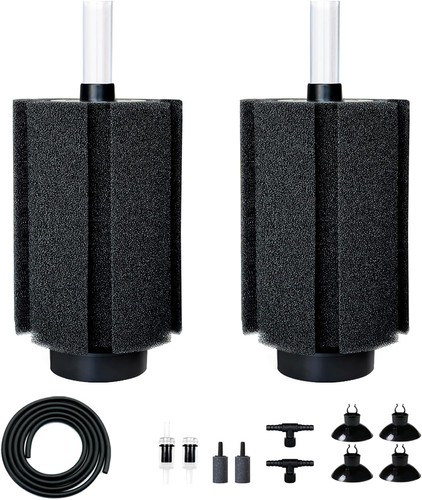
- Unpack and rinse all filter parts. Remove the sponges, uplift tube, and base from the packaging. Rinse each component in dechlorinated water to remove dust and manufacturing residue.
- Assemble the filter base and sponges. Fit the sponges securely onto the filter stems or tubes. If your filter has a weighted base, ensure it’s attached to keep the filter upright in the tank.
- Attach the uplift tube and airline. Connect the uplift tube to the filter body. Run airline tubing from your air pump to the filter’s air inlet, adding a check valve to prevent backflow. For tanks deeper than 18 inches, use a stronger air pump rated for at least 2 L/min output.
- Place the filter in the tank. Position the filter near a back corner or along the side glass, leaving enough space for water flow around both sponges. Press the base down so it sits flat on the substrate.
- Connect and test the air pump. Plug in the air pump and adjust the airflow with a control valve if needed. You should see a steady stream of bubbles rising from both sponges—too few bubbles means insufficient oxygenation, while too many can disturb plants or shrimp.
- Fine-tune placement and flow. Watch how water circulates in the tank. If debris collects in dead spots, shift the filter or adjust the uplift tube angle. For planted tanks, aim for gentle surface agitation and minimal disturbance near delicate stems or carpeting plants.
- Monitor for the first week. Check the filter daily for noise, vibration, or clogged sponges. Rinse one sponge after the first week if water clarity drops, but avoid cleaning both at once to preserve beneficial bacteria.
The spec almost nobody talks about: Pore density and why it matters
Pore density, usually measured in pores per inch (ppi), determines what size particles the sponge will trap—and how easily it will clog. For shrimp or fry tanks, a fine 40–60 ppi sponge prevents tiny creatures from getting sucked in but needs more frequent rinsing. For community tanks with adult fish, a 30–50 ppi medium sponge balances filtration and flow. Heavily stocked tanks or tanks with large waste producers (like goldfish) benefit from 15–30 ppi coarse sponges, which rarely clog but allow some fine debris to pass through. Always match the sponge type to your livestock and maintenance routine.
Compare options for different sponge densities and find the right fit for your tank size and stocking.How to size your air pump for double sponge filters
Underpowered air pumps are a top reason double sponge filters underperform. For tanks up to 20 gallons, an air pump rated for at least 1.5–2 liters per minute (L/min) is a safe starting point. For 20–40 gallon tanks, 2–3 L/min is ideal. If you’re running multiple filters or have deep tanks (over 18 inches), step up to a pump with 3–4 L/min output. Too much airflow can cause excessive turbulence and noise, so always add an adjustable control valve and consider a muffler or placing the pump on a soft pad to reduce vibration. For more on air pump sizing, check out this professional aquatics resource.
View what’s available for adjustable air pumps compatible with double sponge filters.Related Guides
- How to Set Up a Double Sponge Filter: Step-by-Step Guide for Beginners
- Best Pre-Filter Sponges: What to Look For and What to Avoid
- Sponge Filters That Actually Work: Honest Reviews and Recommendations
- Canister Filter vs Sump Filter: Which Is Better for Your Aquarium?
- Hang-On-Back Filter vs Canister Filter: Which Is Right for Your Aquarium?
- How to Replace Aquarium Filter Media: A Step-by-Step Guide
FAQ: Real-world questions about double sponge filters
How often should both sponges be cleaned?
Clean one sponge every 2–4 weeks, alternating sides each time. Avoid cleaning both sponges at once—this preserves the beneficial bacteria that keep your tank stable and prevents ammonia spikes.
Can a double sponge filter replace a hang-on-back or canister filter?
For lightly or moderately stocked tanks under 55 gallons, yes—a double sponge filter provides adequate biological and mechanical filtration. For tanks with heavy bioload, large fish, or if you need chemical filtration (like activated carbon), supplement with another filter type.
What size air pump do I need for a 29-gallon tank?
You’ll want an air pump rated for at least 2–3 liters per minute (L/min) to run a double sponge filter efficiently in a 29-gallon tank. This ensures both sponges receive enough airflow for proper filtration and oxygenation.
Double sponge filter vs. single sponge filter—which is better for planted tanks?
Double sponge filters offer more surface area for bacteria and can be cleaned in stages, making them better for most planted setups. Single sponge filters are fine for nano tanks or breeding setups, but double sponges provide more stable filtration in community tanks.
Will a double sponge filter work in a tank with sand substrate?
Yes, but position the filter base gently to avoid stirring up sand. If sand gets sucked into the sponge, use a slightly coarser pore size (20–40 ppi) and keep the filter a few centimeters above the substrate if possible.
What’s the most common failure mode or complaint?
The most frequent issue is reduced flow due to clogged sponges or an underpowered air pump. Regular cleaning and using an air pump matched to your tank size (see above) will prevent most problems. Air leaks at connections are also common—ensure all fittings are tight and use a check valve to protect your pump.
Are double sponge filters compatible with all tank shapes?
They fit standard rectangular tanks best, but can work in bowfront or rimless tanks if the base is stable. For narrow or oddly-shaped tanks, check the filter’s width—most models are 5–7 inches wide and may need repositioning to avoid crowding plants or hardscape.



Last updated: June 2026 · How we put guides together