
7 min read
Disclosure: As an Amazon Associate and eBay Partner Network publisher, we earn from qualifying purchases. This doesn’t affect what we recommend or how we describe it.
Your new crypt wendtii melts after a week, but your Amazon sword is thriving. You wonder why some aquarium plants never take off—until you spot the roots: stunted, pale, barely alive. This guide breaks down how to use root tabs in real-world planted tanks, so you can finally get lush growth from root-feeding species without wasting tabs, money, or time.
Why root tabs matter (and when you actually need them)
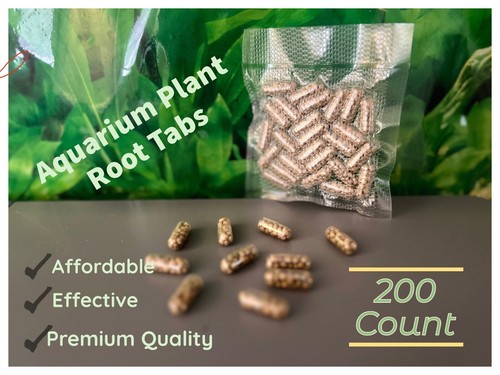
Root tabs are slow-release fertilizer capsules or tablets that you push into aquarium substrate. They’re designed for plants that feed primarily through their roots, like sword plants, crypts, and most stem plants with heavy root systems. If you use inert substrates (plain gravel, sand, or baked clay) or have nutrient-hungry species, root tabs fill the gap left by water column fertilizers alone.
But not every tank needs them. If you use a charged aquasoil or mineralized dirt, your substrate may already be nutrient-rich for months. However, most home aquariums with gravel or sand will see dramatically better growth in rooted plants after adding tabs every 2-3 months. This is especially true for tanks under moderate to high light, where demand is higher.
Root tab types compared: what actually matters for planted tanks
| Format | Release Duration | Typical Size | Nutrient Content | Messiness |
|---|---|---|---|---|
| Gel Capsule | 1-2 months | 12-15 mm | High NPK, micros | Low (if intact) |
| Pressed Tablet | 2-3 months | 8-10 mm | Moderate NPK, some iron | Medium (may crumble) |
| Clay Ball | 3-4 months | 15-20 mm | High iron/clay, low N | High (can cloud) |
| Slow-Release Pellet | Up to 6 months | 6-8 mm | Balanced NPK, trace | Low |
What most buying guides get wrong about root tab dosing
Most packaging tells you to “add one tab every 4-6 inches,” but this advice ignores real tank layouts. In practice, you want tabs within 2-3 cm (about 1 inch) of each heavy root feeder’s base. For crypts or swords, place a tab right under the root ball. For a carpet of dwarf sag or chain sword, stagger tabs every 4-6 inches in a grid pattern. Overdosing is rarely a risk—root tabs release slowly—but placing too few leads to stunted growth in the corners or back of the tank.
Tab size and concentration matter: a 12 mm gel cap typically covers a single large plant for 2 months in a 10-20 gallon tank. Clay-based balls with high iron are ideal for red-leaf species, while slow-release pellets are best for tanks where you want to minimize maintenance. Always check the packaging for N-P-K ratios; values like 10-10-10 (Nitrogen-Phosphorus-Potassium) are common, but iron content (Fe) over 2% is a bonus for crypts and red plants.
See today’s deals on a range of root tab formats to match your specific tank needs.
How to use root tabs: the step-by-step process that actually works
- Identify root-feeding plants. Focus on species like Amazon swords, crypts, vallisneria, and large stem plants with developed root systems.
- Prepare the tab and substrate. Wash your hands, and use tweezers for precise placement. Pinch the tab gently to avoid crumbling, especially if using pressed tablets or clay balls.
- Insert the tab deep into the substrate. Push each tab at least 5-7 cm (2-3 inches) below the surface, directly under the target plant. This keeps nutrients at the root zone and prevents leaching into the water column.
- Space tabs according to plant layout. For grouped plants, add one tab per plant base or every 10-15 cm (4-6 inches) for carpets. Avoid clustering more than two tabs in a single spot to prevent anaerobic pockets.
- Mark placement for future replenishment. Use a plastic plant marker or map the layout on paper, so you know where to re-dose in 2-3 months.
- Monitor plant response and adjust. Watch for new root growth and leaf color. If leaves yellow or growth stalls near the substrate, consider adding tabs more frequently or switching to a higher-iron formula.
Following this process ensures even nutrient delivery and avoids the frustration of wasted tabs or patchy plant growth.
The spec almost nobody talks about: substrate depth and root tab effectiveness
Substrate depth is critical for root tab performance. In tanks with less than 5 cm (2 inches) of substrate, tabs can leach nutrients directly into the water, feeding algae instead of roots. For best results, aim for at least 7-8 cm (about 3 inches) of substrate in root-heavy planting zones. This gives tabs enough buffer to dissolve slowly, allowing roots to absorb nutrients as they grow downward.
For fine sand substrates, use a blunt-ended tool or tweezers to avoid disturbing plant roots or causing tabs to float up. In deep aquasoil, tabs may be unnecessary for the first 4-6 months, but after that, root feeders benefit from targeted re-dosing.
Compare options for root tab shapes and formulas that suit your substrate depth and plant species.
Related Guides
Common mistakes to avoid
- Placing tabs too shallow: Tabs inserted less than 2 cm deep can dissolve into the water, feeding algae and clouding the tank.
- Using tabs in nutrient-rich soil: Adding tabs to fresh aquasoil leads to excess nutrients, algae blooms, and wasted money.
- Ignoring plant spacing: Spreading tabs too far apart, especially in carpets or grouped crypts, leaves many roots unfed.
- Breaking or crushing tabs: Crumbled tabs release nutrients too quickly, causing local ammonia spikes or cloudy water.
- Forgetting to re-dose: Tabs typically last 2-3 months. Skipping replenishment leaves roots starved and plants stunted.
FAQ: Root tab questions every aquarist asks
How long do root tabs usually last in a home aquarium?
Most root tabs last 2-3 months, but release time varies by format. Gel capsules dissolve in 4-8 weeks, while clay balls or slow-release pellets can last up to 4-6 months, especially in tanks with minimal disturbance. Check your packaging for manufacturer-specific duration.
Pressed tablet vs. gel capsule — which is better for crypts?
Pressed tablets work well for crypts in deeper gravel, but gel capsules offer faster nutrient release and are easier to insert near delicate roots. For crypts prone to melting, start with gel capsules and switch to tablets for long-term maintenance.
Will root tabs cause algae blooms in my tank?
Properly placed tabs, inserted deep under plants, rarely cause algae issues. Problems arise if tabs are too shallow or break open, releasing nutrients into the water column. Always push tabs at least 2 inches deep to avoid feeding unwanted algae.
Can I use root tabs with shrimp or sensitive fish?
Most root tabs are safe for shrimp and fish when buried in the substrate. Avoid tabs with high copper content (over 0.05%) if you keep invertebrates. If in doubt, consult reputable aquarium forums or the Planted Tank community for compatibility feedback.
Do I need to remove old root tabs before adding new ones?
No, spent root tabs break down naturally and do not need removal. Simply add new tabs in the same or nearby locations every 2-3 months. Avoid overloading the substrate with more than two tabs per plant at one time to prevent excess buildup.
What should I do if a tab floats up or breaks in the water?
Use aquarium tweezers to quickly retrieve any floating or broken tab. Replace with a new one, ensuring it’s inserted at least 5 cm (2 inches) deep. If water clouds, perform a small water change and monitor for ammonia spikes over the next 48 hours.
Conclusion: Confidently boosting root growth for lush planted tanks
Using root tabs the right way transforms stubborn, slow-growing plants into thriving centerpieces. Match the tab type and placement to your plants and substrate depth, and track your results. Regular, targeted dosing is more effective than guessing or following generic advice. For a range of proven tab formats and formulas, view what’s available and pick the right option for your aquarium setup.



Last updated: July 2026 · About our research