
9 min read
Disclosure: As an Amazon Associate and eBay Partner Network publisher, we earn from qualifying purchases. This doesn’t affect what we recommend or how we describe it.
Auto top off (ATO) systems solve two headaches for aquarium keepers: preventing fluctuating water levels that stress fish and plants, and cutting down on daily maintenance. For high-tech aquascapers, an ATO is about stability—keeping CO2 and nutrients consistent for lush growth. For busy hobbyists or those with nano tanks, it’s about convenience and avoiding disaster if you miss a top-up. And for anyone with a rimless or shallow setup, it’s the line between a pristine display and visible evaporation lines. But not every ATO is built the same, and the right choice depends on your risk tolerance, budget, and how much redundancy you want.
Top picks at a glance
- XP Aqua Duetto2 Dual Sensor Aquarium Auto Top Off System — the premium option with dual sensors
- Fzone Aquarium ATO Auto Top Off Refilling System with Dual Optical Sensor — the budget-friendly recognised-brand pick
Spot the difference between today’s top auto top off systems
Two ATO systems stand out in the current market: the XP Aqua Duetto2 Dual Sensor Aquarium Auto Top Off System and the Fzone Aquarium ATO Auto Top Off Refilling System with Dual Optical Sensor. Both feature dual sensors (a must-have for fail-safe operation), but they land at very different price points and cater to different types of aquarists. Here’s how they stack up on paper and what those differences mean in practice.

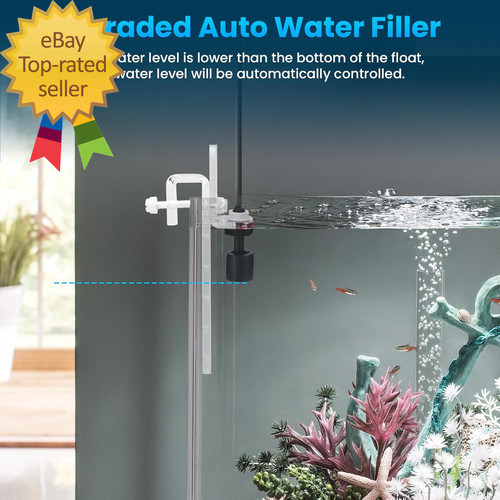
Pictured: XP Aqua Duetto2
| Product | Condition | Price | Best For | Sensor Type | Controller Footprint |
|---|---|---|---|---|---|
| XP Aqua Duetto2 Dual Sensor Aquarium Auto Top Off System |
New | $$$ | Premium, redundancy-focused users | Dual optical | Ultra-slim (0.5″ thick controller) |
 Fzone Aquarium ATO Auto Top Off Refilling System with Dual Optical Sensor Fzone Aquarium ATO Auto Top Off Refilling System with Dual Optical Sensor |
New | $ | Budget setups, value shoppers | Dual optical | Compact (controller <1" thick) |
Note on pricing: the $ symbols are relative tiers within this comparison — $ is the cheapest of the bunch, $$$ the priciest. Live listings (and exact prices) appear further on.
Related Guides
- Canister Filter vs Sump Filter: Which Is Better for Your Aquarium?
- Fine Gravel vs Coarse Gravel: Which Substrate Is Best for Your Aquarium?
- Our guide to Hang-On-Back Filter vs Canister Filter: Which Is Right for Your Aquarium?
- LED vs Fluorescent Aquarium Lighting: Which Is Better for Your Tank?
- Sand vs Gravel Substrate: Which Is Best for Your Aquarium?
- How to Choose an Aquarium Stand With Fish Tank: A Complete Guide
- Browse all Filtration Systems →
Choose the right ATO for your tank—and your nerves
Both the XP Aqua Duetto2 and Fzone ATO use dual optical sensors. This design is the current hobbyist consensus for reliability—optical sensors aren’t affected by mineral buildup the way float switches can be, and dual sensors provide a backup if one fails or gets obstructed. But there are meaningful differences to weigh.
- XP Aqua Duetto2: The standout here is the ultra-slim controller, just 0.5 inches thick, making it easy to tuck behind or beside even small rimless tanks. Its dual sensors are housed in a single compact module, reducing cable clutter. It’s positioned as the safe bet for anyone who wants premium build, minimal installation footprint, and the peace of mind that comes with a brand known for redundancy. The price reflects this—expect to pay at the high end for the extra engineering and reputation.
- Fzone ATO: This model offers dual optical sensors at a budget price, a rare combination. The controller is still compact (under 1 inch thick), though not quite as slim as the Duetto2. The Fzone is from a recognized brand in planted-tank gear, and while it may not have the same high-end finish, it covers the core feature set: two optical sensors, simple installation, and a straightforward controller. It’s the logical pick for budget-conscious aquarists who want the safety of dual-sensor tech without the premium markup.
If your tank is open-top, shallow, or in a hot/dry room where evaporation swings are severe, the redundancy of dual optical sensors is a non-negotiable. For high-value livestock or aquascapes where even a small overfill could cause a mess, the XP Aqua Duetto2’s added polish and minimal footprint can be worth the investment. For most standard tanks (up to about 100 gallons), the Fzone ATO covers the bases at a price that leaves room in your budget for other upgrades.
How we narrowed it down: our ATO research criteria
For this shortlist, we focused on ATO systems that meet the current best-practice standards for reliability and safety in home freshwater and planted aquariums. Here’s what mattered most:
- Dual sensor redundancy: Both options use dual optical sensors, which are less prone to failure from debris or mineral films than float switches. Single-sensor ATOs or float-only designs were excluded for not meeting the current hobbyist consensus on reliability.
- Controller footprint and ease of installation: ATOs with bulky controllers or complicated mounting were left out. Both models here offer controllers under 1 inch thick, making them suitable for rimless and nano tanks.
- Brand reputation and support: Only established brands with a track record in the planted or reef aquarium space made the cut. Unbranded or “kit bundle” ATOs with unclear specs were excluded, as were any models lacking a clear warranty or support channel.
- Value for money: Both premium and budget picks are represented, but each must deliver dual-sensor safety and a straightforward setup. No-frills single-sensor models didn’t make the list, even if cheaper, due to the real risk they pose for overfilling or running dry.
This guide is for aquarists who want to automate top-off safely, not for those looking to DIY from scratch or run without redundancy. If you have a very large tank (over 150 gallons), or need remote monitoring or WiFi integration, these options may not cover your needs—you’ll want to look at specialty or commercial-grade ATOs instead.
Why dual optical sensors are the new standard
Evaporation is a reality for every aquarium, but the risks of manual top-offs go beyond convenience. Even a few millimeters of lost water can swing salinity in marine tanks or mess with CO2 levels and nutrient dosing in high-tech planted setups. Dual optical sensors provide two crucial safeguards: they detect the water line with precision (typically within 1-2 mm) and provide a backup if one sensor gets fouled or fails. This redundancy is what separates modern ATO systems from older, float-based designs.
According to the Marine Aquarium Societies of North America, sensor-based ATOs have become the recommended approach for both saltwater and freshwater hobbyists, mainly because they minimize the risk of overfilling or running pumps dry. While both the Duetto2 and Fzone use this technology, the Duetto2’s housing and integration are a step up in compactness—an edge if you want minimal visual intrusion.
Where installation and fit really matter
Both the XP Aqua Duetto2 and Fzone ATO are designed to fit a broad range of aquariums, from small nano tanks to mid-sized displays. Their slim controllers and all-in-one sensor modules mean you don’t need a sump or drilled tank—just a clear spot on the glass, usually near the return section or a quiet corner. Both come with mounting hardware suitable for standard glass thicknesses (typically up to 12 mm), but always check your tank’s rim and space before committing.
One subtle difference: the Duetto2’s controller is about 0.5 inches thick, making it especially suited to tanks with minimal clearance behind the glass or where you want to hide all electronics. If you’re running a rimless or shallow tank where aesthetics are key, this can be a deciding factor. The Fzone ATO’s controller is slightly bulkier but still compact enough for most setups, and the price savings are significant if space isn’t at a premium.
Total cost of ownership
Sticker price is only part of the equation with any ATO system. Here are the main ongoing or hidden costs you should expect:
- Pump replacement: Most ATOs use a small DC pump, which typically lasts 1-2 years of daily cycling. Expect to replace it every 12-24 months, with costs ranging from $10-$25 per pump.
- Tubing and fittings: Standard airline or silicone tubing is included, but may need replacement every 1-2 years as it becomes brittle or clogged. Budget $5-$10 per year for fresh tubing and any spare fittings.
- Sensor cleaning: Optical sensors can accumulate biofilm or mineral deposits, especially in hard water. Plan to clean them every 2-3 months with a soft cloth or vinegar solution. No direct cost, but it’s a time investment to keep sensors accurate.
- Water container: Most ATOs do not include a reservoir. You’ll need a dedicated container (often a 2-5 gallon jug or purpose-built tank), which typically runs $10-$40 depending on size and material.
- Energy consumption: The DC pumps used in these systems typically draw 2-5 watts, adding up to a negligible annual cost (well under $5/year), but worth noting for total system load.
Factoring in these costs gives a truer sense of what you’ll spend over a few years of ownership. The main variable is pump life; keeping a spare on hand is smart for uninterrupted operation.
FAQ: Get your ATO questions answered
How often do the sensors need cleaning, and what happens if you skip it?
Optical sensors should be checked and wiped clean every 2-3 months. In hard water or tanks with lots of surface film, monthly is safer. Skipping this can lead to inaccurate readings or the backup sensor being triggered more often, which defeats the redundancy.
Is the XP Aqua Duetto2 worth the premium over the Fzone ATO?
For aquarists with high-value livestock, minimal installation space, or a history of ATO mishaps, the XP Aqua Duetto2’s slimmer profile and brand reputation justify the higher price. For standard setups where cost is the main concern and space isn’t ultra-tight, the Fzone ATO delivers similar core safety at a much lower price point.
Can I use these ATOs on a rimless or nano tank?
Yes, both models are designed for rimless and nano tanks, with slim controllers and small sensor modules. Always check the mounting hardware for compatibility with your glass thickness, but both are commonly used on tanks as small as 5 gallons.
What’s the typical lifespan of the included pump in these ATO systems?
Most DC pumps in ATOs last between 12 and 24 months under daily use. This can vary with water quality, pump placement, and maintenance. Keeping a backup pump is recommended to avoid downtime if the main one fails.
Are these ATOs compatible with saltwater as well as freshwater tanks?
Both the XP Aqua Duetto2 and Fzone ATO use optical sensors, which work in both freshwater and saltwater. Just note that salt creep (evaporated salt deposits) can build up faster in marine setups, so more frequent sensor cleaning may be required.
What if I need to return or exchange an ATO system?
Return and warranty policies vary by retailer and brand. Both XP Aqua and Fzone have support channels, but always check the specific seller’s return window and warranty terms before purchase. Buying from established aquarium retailers or platforms with clear return policies is best for peace of mind.
The bottom line: Which ATO fits your aquarium goals?
If your priority is maximum reliability and a discreet installation—especially on rimless tanks or high-value aquascapes—the XP Aqua Duetto2 justifies its premium cost. For most home aquarists, especially those starting out or running standard planted tanks, the Fzone ATO offers dual-sensor safety at a price that’s hard to beat. Both leave single-sensor and float-switch models in the dust for reliability. Just remember: maintenance (especially cleaning sensors and replacing pumps) is the real key to long-term, worry-free top-off.
For more on modern aquarium automation, see guidance from the Marine Aquarium Societies of North America or consult your local aquarium society for best practices.
Last updated: June 2026 · About our research