9 min read
Disclosure: As an Amazon Associate and eBay Partner Network publisher, we earn from qualifying purchases. This doesn’t affect what we recommend or how we describe it.
Digital aquarium thermometers with probes are available for as little as $10, but the range in accuracy, probe durability, and waterproofing is huge—often the difference between stable tank conditions and hours spent troubleshooting false readings. For planted tank keepers, especially those running CO2 or sensitive livestock, knowing your tank’s true temperature is not optional. Here’s how to choose a probe thermometer that actually delivers reliable, real-time data, without wasting money on gear that won’t last a full season.
Why probe thermometers outperform stick-on and floating types
Probe-based digital thermometers measure the water temperature directly, not the glass or the air around your tank. In planted tanks, where light intensity, flow, and heater placement can create subtle gradients, a probe delivers readings within ±0.5°C accuracy—far superior to most stick-on strips, which can be off by 2°C or more. Floating glass thermometers are prone to breakage and can get stuck behind hardscape or plants, while probe models can be positioned exactly where you want to monitor—such as near your heater output, under dense plant cover, or in a sump return.
Comparing the main types of digital aquarium thermometer with probe
| Configuration | Display Type | Probe Cable Length | Accuracy | Water Resistance | Price |
|---|---|---|---|---|---|
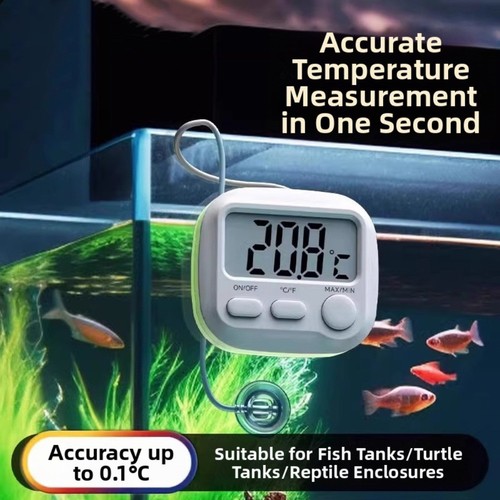
| The budget-friendly pick | Small LCD panel | 80–100 cm | ±1.0°C | Probe waterproof, display not | $ |
| The most feature-rich choice | Wireless receiver | Up to 5 m (wireless signal) | ±0.5°C | Probe fully submersible | $$$ |
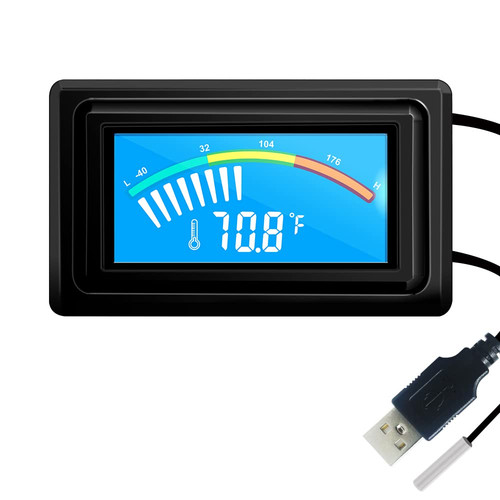
| The mid-range, panel-mount option | Large backlit LCD | 150–200 cm | ±0.3°C | Probe waterproof, panel splash-resistant | $$ |
| The multi-tank monitoring solution | Multi-line digital | 2–3 probes, each 100–150 cm | ±0.2°C | All probes submersible | $$$ |
| The simplest, compact display | Mini LCD | 40–60 cm | ±1.0°C | Probe water-resistant, not for full submersion | $ |
The price column compares within this guide: $ is the budget end, $$ mid, $$$ premium. For exact, up-to-date prices, see the live listings lower in the article.
The price column compares within this guide: $ is the budget end, $$ mid, $$$ premium. For exact, up-to-date prices, see the live listings lower in the article.
Probe length, accuracy, and placement: What matters for planted tanks?
For most home aquascapes under 120 cm (4 feet), a probe cable of at least 80 cm allows for flexible placement—whether you want to hide the probe behind hardscape or reach a sump. Multi-probe systems are overkill unless you’re running multiple tanks or need to monitor both your display and a separate breeder box. Accuracy is critical if you keep sensitive species or run CO2 injection: aim for ±0.5°C or better. Based on manufacturer specifications, anything looser than ±1.0°C will mask real heater drift and make troubleshooting algae or livestock stress harder.
Display readability is another often-overlooked factor. A 1.5–2 cm tall LCD is easy to check from across the room. Backlighting helps in low-light rooms, but is not essential if your tank area is well-lit. Consider where you’ll mount the display—panels that aren’t at least splash-resistant tend to fail fast in humid fish rooms.
Looking for a mid-range, panel-mount option with a 150 cm probe cable? Compare options for the best fit for your setup.
How waterproofing standards affect probe lifespan
Many budget probe thermometers claim “waterproof” but only the probe itself is safe for submersion—the display is often just splash-resistant or must be kept dry. True IP67 or IP68-rated probes withstand full submersion long-term (weeks to months). Anything less will eventually corrode or short out. For planted tanks with high humidity or misting, look for explicit IP ratings in the specs. According to product listings and user reports, generic “water-resistant” probes typically last 6–12 months before erratic readings start, while IP67+ models are reported to go 2+ years without issues.
If you run a rimless tank and want a clean look, adhesive-backed probes are less obtrusive, but always check the cable length—they’re often 40–60 cm, which can be too short for deeper tanks or sumps.
Are wireless probe thermometers worth the premium?
Wireless probe thermometers use radio signals or Bluetooth to transmit readings to a receiver outside the tank area, eliminating the need for a cable draped over your rim or hood. This is most useful for tanks where cables would disrupt your aquascape, or for racks with multiple tanks. Expect to pay at least double the price of a quality wired unit, but you’ll gain flexibility and less clutter around your tank. However, wireless models require more frequent battery changes (often every 3–6 months), and signal interference from metal stands or thick glass can reduce reliability. Unless you need the cleanest look or have a complex setup, a basic wired probe is usually sufficient.
For high-tech setups, multi-probe systems can track multiple tanks or zones (e.g., both display and sump). Just be ready for a steeper learning curve and more calibration.
Ready to upgrade to wireless or multi-probe? See today’s deals for advanced options.
Related Guides
- Our guide to Aquarium Air Stones That Actually Work: Our Top Picks for Healthy Tanks
- Our guide to Aquarium Canister Filters That Actually Work: Top Picks for 2026
- Aquarium Circulation Pumps That Are Actually Worth Buying
- Aquarium Heaters With Guards That Are Worth Buying
- Aquarium Plant Anchors That Actually Work: Our Top Recommendations
- Our guide to Aquarium Surface Skimmers That Actually Work: Our Top Picks and Reviews
- Browse all Aquarium Tanks →
Red flags in listings to walk past
- No stated accuracy range: Listings that omit a ±0.X°C or °F figure usually have poor quality control. Without a published spec, expect unpredictable readings.
- Probe “waterproof” but no IP rating: True waterproofing is always backed by an IP67 or IP68 spec. “Water-resistant” or “splash-proof” without details means the probe may fail quickly if fully submerged.
- No cable length specified: Sellers who don’t state the probe cable length are often reselling generic stock. Too-short cables are a common cause of frustration in planted tank layouts.
- Stock photos only, no close-ups: Avoid listings with just generic product images and no real photos of the probe, display, and connectors. This often signals a drop-shipper with no actual product knowledge.
- Suspiciously low price for “multi-probe”: True multi-probe systems cost significantly more than basic wired units. Ultra-cheap “3-in-1” listings are usually unreliable or simply duplicate the same reading across all “probes.”
Calibration and maintenance: Keeping your readings reliable
Even the best digital aquarium thermometer with probe can drift over time. Models with manual calibration (a small adjustment screw or button) let you fine-tune readings against a trusted reference. For most hobbyists, calibrating every 6–12 months is sufficient. To check accuracy, immerse the probe in a glass of water with crushed ice (should read close to 0°C/32°F) or in water at room temperature (about 20–22°C/68–72°F). Clean probes monthly with a soft cloth—never use abrasives or strong chemicals.
Battery life varies by configuration: basic wired units often last 12–18 months on a single button cell; wireless and backlit models may need new batteries every 3–6 months. Always replace batteries at the first sign of erratic readings or dim displays.
For more on calibration and measurement standards, see the ASTM International guidance on temperature measurement devices.
Installation tips for hassle-free monitoring
Mount the probe in an area with good flow, away from direct heater output or filter inlets, for the most representative tank temperature. Avoid burying the probe in substrate or wedging it deep in plant mass, as this can insulate it and skew readings. Secure cables with suction cups or clips to prevent curious fish or shrimp from pulling them loose. Keep the display away from splashing water or condensation—especially in open-top or rimless setups. If you want a truly clean display, consider mounting the panel on your stand or wall near the tank.
To minimize cable clutter, choose a configuration with just enough length for your setup. Excess cable can be coiled and secured behind your stand, but avoid tight bends that could damage the wires over time.
Want to see which probe length fits your tank? View what’s available for current options and specs.
FAQ: Digital aquarium thermometer with probe
How long does a typical probe last in a freshwater tank?
Most decent-quality probes last 12–24 months before readings drift or fail, especially if they’re IP67-rated and kept clean. Cheaper or uncertified probes may develop corrosion or erratic readings in as little as 6 months. Regular cleaning and avoiding full submersion of non-waterproof parts can extend lifespan.
Is a ±1.0°C accuracy rating good enough for a planted tank?
For casual community tanks, ±1.0°C is usually sufficient. However, for tanks with sensitive livestock, CO2 injection, or if you’re troubleshooting heater issues, aim for ±0.5°C or better. More precise readings help you spot temperature swings before they stress your plants or fish.
Wired vs wireless probe thermometers: which is better for a home aquarium?
Wired probe thermometers are more reliable, need fewer batteries, and cost less. Wireless models are neater and ideal if you dislike visible cables, but they’re pricier and require more frequent battery changes. For most home tanks, a wired probe offers the best balance of accuracy and simplicity.
Can I use the same thermometer for multiple tanks?
If you choose a multi-probe system, you can monitor several tanks at once, but these setups are more expensive and require careful calibration. Moving a single-probe thermometer between tanks is possible, but risks cross-contamination and is less convenient. For most hobbyists, one probe per tank is best.
What should I do if my display fogs up or the reading jumps around?
Fogging or erratic readings usually mean condensation or water ingress. First, dry the display and check for cracks or loose seals. If problems persist, the unit may not be splash-resistant enough for your setup; replacing it with a better-sealed model is the safest solution. Always keep non-waterproof displays dry.
Are there any compatibility issues with rimless or extra-thick glass tanks?
Most probes work fine with rimless tanks, but adhesive or suction cup mounts may not stick as well to ultra-smooth glass. For extra-thick glass (over 12 mm), check that the probe cable and mounting hardware can accommodate the thickness, and avoid tight bends that could pinch the cable as it passes over the rim.
Do digital probe thermometers come with a warranty?
Warranty coverage varies widely. Basic models may have no warranty or just a 30-day guarantee, while mid-range and premium options sometimes offer 6–12 months. Always check the seller’s return policy before buying, and keep your receipt in case of early failure.
Further reading and trusted references
For an in-depth look at aquatic temperature standards and best practices, see the FishBase database for species-specific temperature ranges, or review general aquarium husbandry guidelines at Ornamental Fish International.
Related Guides
- Our guide to Aquarium Air Stones That Actually Work: Our Top Picks for Healthy Tanks
- Our guide to Aquarium Canister Filters That Actually Work: Top Picks for 2026
- Aquarium Circulation Pumps That Are Actually Worth Buying
- Aquarium Heaters With Guards That Are Worth Buying
- Aquarium Plant Anchors That Actually Work: Our Top Recommendations
- Our guide to Aquarium Surface Skimmers That Actually Work: Our Top Picks and Reviews
- Browse all Aquarium Tanks →
Last updated: June 2026 · About our research